NSW Local Jobs First procurement reform: what SMEs need to prove in government tenders
The short answer: NSW's proposed Local Jobs First procurement reforms could give more weight to local jobs, local content and SME participation. But a local weighting does not replace a strong bid. SMEs still need to show who will do the work, where the capability sits, which local suppliers are involved, how delivery risk is managed, and what evidence supports each claim.
Procurement and Supply Australasia reported on 1 June 2026 that the NSW Government's proposed Local Jobs First Commission legislation would introduce a Local Procurement Policy with a 30 percent tender weighting for local jobs and skills, local content, and small and medium business participation.
For local suppliers, that is significant.
As at 15 June 2026, this is proposed legislation, not a final operating rule. Bid teams should treat it as an early signal of where NSW procurement policy may be heading and confirm the final requirements in each RFT.
What is NSW Local Jobs First?
As reported by Procurement and Supply Australasia, the NSW Government's proposed Local Jobs First Commission legislation is designed to put local businesses, local jobs, local skills and local content closer to the centre of procurement decisions.
The reported reforms include a proposed 30 percent tender weighting for local jobs and skills, local content and SME participation; Local Procurement Plans for major contracts; a Local Jobs First Commissioner; a Local Jobs First Advisory Board; training requirements for apprentices and workers on major state projects; and a possible supplier debarment scheme following ICAC Operation Hector recommendations.
The bill is still something suppliers should track carefully. But the practical message is already clear.
Local value will need evidence.
What the 30 percent local weighting could mean for SMEs
A higher weighting may help SMEs get a stronger look from government buyers.
That does not mean smaller suppliers can submit weaker responses.
It means the parts of the response dealing with local jobs, local capability, local suppliers and local economic value may become more important.
For SMEs, the opportunity is not just being eligible.
It is being ready to prove why local participation improves the bid.
What local suppliers should prepare
If your business wants to compete for NSW Government work, start organising the evidence before the RFT arrives.
A strong response should be able to show:
- who will do the work
- where the team is based
- which local suppliers or subcontractors are involved
- what jobs or skills will be supported
- what capability stays in NSW
- how apprentices, trainees or new workers may be supported
- how local knowledge reduces delivery risk
- what previous projects prove you can deliver
This is where many bid teams lose time.
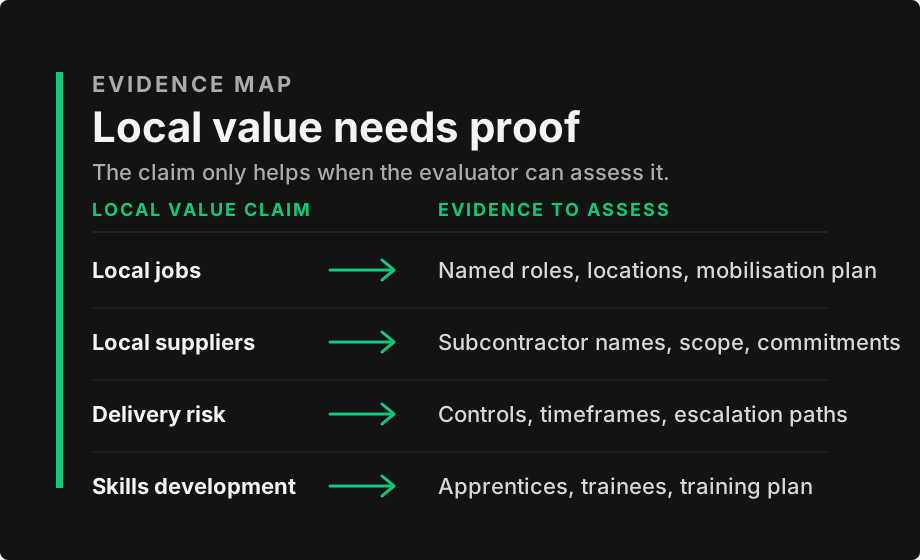
Local value needs to be mapped to evidence before the evaluator can score it.
The evidence exists, but it is scattered. A case study sits in last year's proposal. A supplier detail is buried in a spreadsheet. A CV needs updating. A project manager remembers the example, but not the numbers. The bid writer spends the first week finding proof instead of shaping the response.
That is expensive time to lose.
Why "we are local" is not enough
Government evaluators need to assess the response in front of them.
They may care that a supplier is local. But they still need to see capability, delivery confidence, value for money, risk management and compliance with the RFT.
A local supplier still needs to answer the buyer's criteria.
A better tender response connects local value to the contract itself.
For example, local staff may be able to mobilise faster. Local subcontractors may reduce supply chain risk. Local knowledge may improve delivery planning. Local training commitments may build workforce capability. Previous NSW projects may prove relevant experience.
That is stronger than a generic paragraph about supporting the local economy.
The practical takeaway for bid teams
If the NSW reforms proceed as reported, SMEs should not wait until the next tender lands.
The work starts earlier.
Build the evidence base now. Keep case studies current. Know which suppliers you can name. Keep CVs, certifications and project details organised. Make sure local value claims can be backed up.
Procurement reform may open the door wider for local suppliers.
The bid still has to stand up.
How Doreva helps
Doreva is built for Australian businesses responding to government tenders.
It helps bid teams turn RFT documents, past proposals, case studies, CVs, certifications and real project evidence into a working first draft their team can review, refine and own.
For SMEs, that matters because local value is only useful if it makes it into the response clearly.
Doreva helps connect your evidence to the buyer's requirements, so the bid is not starting from a blank page every time.
FAQs
What is the NSW Local Jobs First procurement reform?
The NSW Local Jobs First procurement reform is proposed legislation reported in June 2026 that would put local jobs, local skills, local content and SME participation closer to the centre of NSW Government procurement decisions.
What is the proposed 30 percent local weighting?
Procurement and Supply Australasia reported on 1 June 2026 that the proposed Local Procurement Policy would apply a 30 percent tender weighting for local jobs and skills, local content, and small and medium business participation.
Does local weighting mean SMEs will automatically win more tenders?
No. A local weighting may improve the opportunity for SMEs, but suppliers still need to submit compliant, evidence-backed responses that prove they can deliver.
What should SMEs prepare for NSW Government tenders?
SMEs should prepare current case studies, local supplier details, team CVs, certifications, delivery examples, risk controls and evidence of local jobs, local content and capability.
Local value only helps if the evaluator can see it.
Start the free pilot with a live tender. Doreva reads the RFT and shows the requirements and evaluation criteria first. Upgrade when you are ready to turn your past proposals and evidence library into a working first draft your team can review and own.
Start Free PilotBuilt for Australian Government tenders. Human review before every export.
Sources: Procurement and Supply Australasia, published 1 June 2026. Status note: this article treats the reform as proposed legislation as at 15 June 2026. Always check current NSW Government procurement guidance and the specific RFT before relying on a weighting or requirement.