AI Governance in Proposal Writing: What Australian Bid Teams Need to Know
AI is already being used in proposal writing.
Some teams use it to summarise tender documents. Some use it to draft sections. Some use it to reuse evidence from past bids. Some use it quietly and hope it never becomes a question.
That unevenness is where Australia is right now.
We do not yet have one neat national AI law that tells every proposal team exactly what to disclose, how to disclose it, and what record to keep. But that does not mean there are no expectations.
The direction is clear.
Australian government buyers are starting to think about AI the same way they think about other procurement risks: probity, privacy, accountability, evidence and human judgement.
Where Australia is now
Australia does not currently have a single economy-wide AI Act like the European Union.
Instead, AI governance is developing through a mix of existing laws, government policy, voluntary standards and proposed mandatory guardrails for higher-risk AI use.
Existing laws still matter. Privacy law still applies. Consumer law still applies. Procurement obligations still apply. Confidentiality obligations still apply. If AI is used in a way that mishandles buyer information, creates unsupported claims, or misrepresents how a submission was prepared, the issue is not just "AI". It is governance.
The Australian Government has introduced voluntary AI safety standards and has consulted on mandatory guardrails for high-risk AI. Those guardrails point to themes that should be familiar to anyone in government procurement: risk management, transparency, testing, human oversight, record keeping and accountability.
In the public sector, AI use is also becoming more formalised. Government agencies are being asked to think about responsible AI, transparency and public trust.
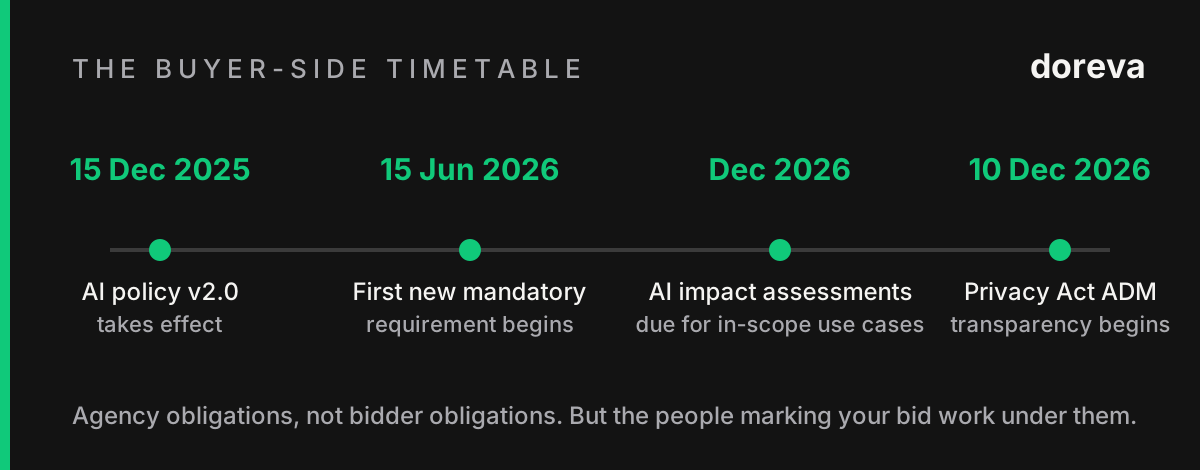
The buyer-side rules do not automatically become bidder-side rules. But they shape the questions buyers are starting to ask.
That is the environment proposal teams are now bidding into.
What this means for proposal writing
For years, the main question in a tender response was whether the supplier could deliver.
That question has not gone away.
But AI adds another layer.
If AI helped prepare the response, a buyer may reasonably want to know what AI was used for, who reviewed the output, who made the final decisions, what evidence supports the claims, how buyer information was protected, and whether the supplier can stand behind the final submission.
These are not theoretical questions.
They sit directly inside normal procurement concerns. A tender response is not just a piece of writing. It is a formal business document that may include pricing, commitments, risk positions, delivery methods, credentials and claims about past performance.
If AI helped shape that document, the bid team needs to remain accountable for it.
The risk is not AI use. The risk is unaccountable AI use.
Using AI in proposal writing is not automatically a problem.
In many cases, it can help teams move faster, organise evidence, reduce repetitive drafting and get to review earlier.
The risk comes when there is no record.
No record of what was drafted. No record of what was reviewed. No record of where claims came from. No record of who made the judgement calls.
That creates a problem when a buyer asks a simple question: how was AI used in this response?
A vague answer will not be enough for serious government work.
Where we are going next
The next stage of AI in proposal writing will not be about speed alone.
Speed was the first stage.
The next stage is accountability.
Bid teams will still want faster first drafts. They will still want better reuse of evidence. They will still want help turning complex tender packs into clear response structures.
But they will also need governance around that work.
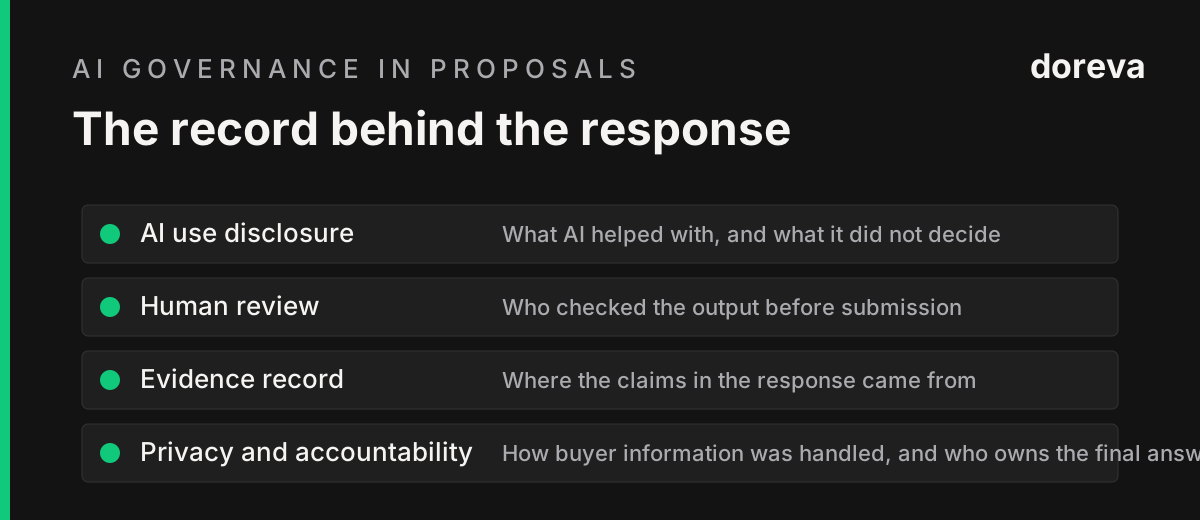
A practical governance trail should answer the buyer's question without forcing the bid team to reconstruct the process after the fact.
That means AI use disclosure that is ready before the buyer asks, human review clearly documented, evidence linked back to the response, privacy and confidentiality handled deliberately, and final accountability sitting with the people submitting the bid.
This is where government proposal writing is heading.
Not because every buyer will ask for a detailed AI record tomorrow. Because serious bidders will want to be ready when they do.
August 2026 update: the DTA tells agencies to run AI at scale
Since this article was first published, the direction has firmed up.
On 4 August 2026, Lucy Poole, Deputy CEO at the Digital Transformation Agency, told the Tech in Gov conference that the conversation has moved from AI pilots to whole-of-government scale under the APS AI Plan. The speech asked industry to design for transparency, interoperability, cost visibility and changing assurance needs from the start, and said agencies still need notification thresholds, audit trails, testing, rollback and the ability to pause a system when risk is unclear.
The DTA also said something bid teams should sit with: partnership must extend beyond procurement into continuous operational assurance. The questions do not stop at contract award.
We have unpacked the speech and what it means for anyone selling into government in a dedicated guide: the DTA's AI at scale speech and what vendors will need to show.
How AI automates compliance matrices for AusTender submissions
The clearest example of accountable AI use in bidding is the compliance matrix, so it is worth walking through the mechanics.
A compliance matrix is the document that proves every requirement in a tender has been answered. Built by hand, it means reading the full RFT pack clause by clause, usually in a spreadsheet, usually late in the response when errors are hardest to fix. It is also the step where AI automation is most mature. The process runs in four steps:
- Ingest the tender pack. The RFT, RFQ or ATM documents from AusTender are uploaded in full: conditions of participation, statement of requirement, response schedules, draft contract and attachments.
- Identify and classify every requirement. AI separates mandatory requirements, the pass-or-fail conditions where a miss can see a response set aside without being scored, from weighted evaluation criteria that earn marks, and from administrative requirements like lodgement format and deadlines.
- Map each requirement to a response section. Every clause is linked to the section of the response that addresses it and the evidence attached to support it, so coverage is visible rather than assumed.
- Flag gaps before drafting begins. Requirements with no planned response, claims with no supporting evidence, and certifications that are missing or expired surface at the start of the response window, when there is still time to fix them.
Here is what a working matrix looks like in practice:
| Requirement reference | Type | Response section | Evidence attached | Status |
|---|---|---|---|---|
| RFT 3.2.1 Public liability insurance, $20M minimum | Mandatory | Section 2: Corporate compliance | Certificate of currency | Met |
| RFT 4.1 Demonstrated experience delivering similar services | Weighted | Section 4: Past performance | Three case studies with referees | Met |
| RFT 3.4 Certified WHS management system | Mandatory | Section 2: Corporate compliance | Certification expired last quarter | Gap |
| RFT 4.3 Transition-in methodology | Weighted | Section 5: Delivery approach | Draft methodology, no named transition lead | Partial |
An illustrative example. The gap row is the point: a lapsed WHS certification found in week one is a renewal task, and found at lodgement it is a lost bid.
The governance angle is what makes this belong in this article. An automated compliance matrix is not just faster, it is a record. It documents how every requirement was identified, where it was addressed, and what evidence stood behind the answer, at the moment those decisions were made. When a buyer asks how AI was used in preparing the response, the matrix is part of the answer: it shows AI doing the structured reading and cross-checking, with the bid team reviewing each mapping and owning the judgement calls. That is exactly the auditable trail the disclosure expectations above are asking for, and it comes out of the workflow as a by-product rather than being reconstructed after the fact.
FAQ
What did the DTA say about AI at scale in August 2026?
In a speech delivered on 4 August 2026, the Digital Transformation Agency said the task for government has moved from AI pilots to whole-of-government scale under the APS AI Plan, and that government needs industry to design for transparency, interoperability, cost visibility and changing assurance needs rather than bolting them on after deployment.
For bid teams, the practical signal is that buyers are being equipped to ask specific questions about how AI is governed, in delivery and in bid preparation.
Do Australian government tender responses need AI disclosure?
Not always in a single standard format.
Australia does not currently have one national rule that says every AI-assisted tender response must include the same AI disclosure statement. But government buyers can ask suppliers how a response was prepared, how AI was used, who reviewed the work, and how information was handled.
If AI helped draft, summarise, analyse or structure a tender response, bid teams should be ready to disclose that use clearly and honestly if asked.
What is AI governance in proposal writing?
AI governance in proposal writing is the process of keeping control over how AI is used to prepare a bid.
It includes knowing what AI was used for, what information went into it, who reviewed the output, what evidence supports the claims, how buyer information was protected, and who remains accountable for the final submission.
In simple terms, it is the record behind the AI-assisted response.
How should bid teams disclose AI use in government bids?
Bid teams should keep the disclosure clear, factual and proportionate.
A useful AI disclosure should explain what AI was used for, what it was not used for, who reviewed the output, who made the final commercial and delivery decisions, and how confidential or buyer-provided information was handled.
The disclosure should not over-explain the technology. It should give the buyer confidence that the supplier used AI responsibly and that humans remain accountable for the final response.
Can AI automatically generate a compliance matrix from an AusTender document?
Yes. AI can read an AusTender RFT, RFQ or ATM pack and generate a compliance matrix in minutes: it extracts every requirement, classifies mandatory conditions of participation separately from weighted evaluation criteria, maps each requirement to the response section that addresses it and the evidence attached, and flags gaps before drafting starts.
The bid team then reviews the matrix rather than building it by hand. Human review remains essential, because the team, not the tool, is accountable for the submission.
What should a compliance matrix include for a Commonwealth government tender?
A useful compliance matrix for a Commonwealth tender lists every requirement with its source clause reference, classifies it as a mandatory condition of participation or a weighted evaluation criterion, records which response section addresses it, notes the evidence attached, and tracks a status of met, partial or gap.
Mandatory requirements matter most: missing one can see a response set aside without being scored, so the matrix should make every unresolved gap visible well before lodgement.
Why we built AI governance exports into Doreva
This is why we built AI governance exports into Doreva.
Doreva is built for Australian government tenders. That means the product cannot just help teams draft faster. It also has to support the way government bids are actually evaluated, reviewed and defended.
A useful governance export should help a bid team answer the questions a government buyer is most likely to ask:
- where AI assisted the proposal process
- what content was reviewed by the bid team
- what evidence sat behind the response
- how confidential or buyer-provided information was handled
- who remained accountable for the final submission
The goal is simple.
Help bid teams use AI without losing control of the record behind the response.
Because in government proposals, the answer is only part of the job.
You also need to be able to show how you got there.
If you are still weighing where AI fits in your bid process, start with our take on whether AI will replace tender writers. If your team is still getting the basics of tender structure in place, read our guide to understanding tender requirements.
Move faster without losing the record.
Start the free pilot with a live tender and see how Doreva helps Australian bid teams prepare government proposals with AI governance built into the workflow.
Start Free PilotBuilt for Australian government tenders. Human judgement stays with the bid team.