AI in Australian Government Contracting: Key Trends and What to Expect in 2026 and Beyond
The short answer: AI in Australian government contracting is moving from experimentation to accountability. The buyer side formalised its rules through late 2025 and 2026, disclosure questions are appearing in live tenders, and the tools winning on the supplier side are the ones built for compliance rather than fluent prose. For SMEs, this shift lands on top of procurement rules that already favour them, which is why the most interesting trend is not the technology. It is who the technology lets compete.
Here are the five trends we think matter most, what sits behind each one, and what a bid team should do about it.
Trend 1: AI disclosure moves from occasional question to standard practice
Australia still has no single national rule requiring a standard AI disclosure statement in every tender response. What it has is a clear direction of travel. The Commonwealth's policy for responsible use of AI in government took effect in version 2.0 form on 15 December 2025. Its first mandatory requirement applied from 15 June 2026, agencies face AI impact assessments due by December 2026, and Privacy Act transparency obligations for automated decision-making commence on 10 December 2026.
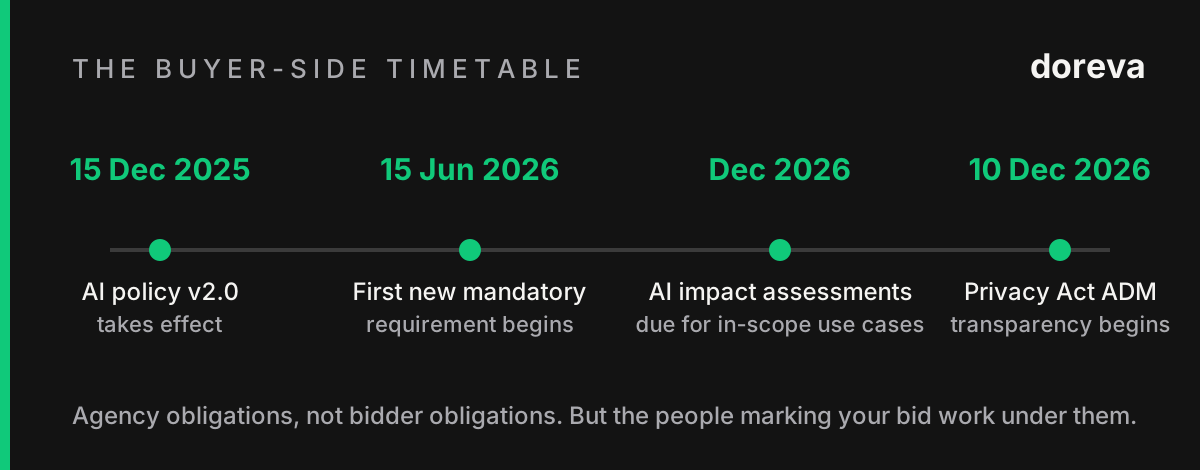
The buyer-side rules do not automatically become bidder-side rules. But they shape the questions buyers ask suppliers.
Those are buyer-side obligations, but they change supplier-side expectations. A buyer operating under formal AI accountability rules is a buyer who will ask how your response was prepared, who reviewed it, and how their information was handled. Those questions are already appearing in tenders, and we expect them to become as routine as insurance schedules. The bid teams that will not feel this shift are the ones keeping a record as they go: what AI was used for, what humans reviewed, and what evidence sits behind each claim. We covered the specifics in what the buyer can now ask you, and it is why Doreva builds an AI governance export into every proposal.
Trend 2: Compliance-first AI tools displace generic assistants for government bids
The first wave of AI in bid writing was generic: paste the question into a general-purpose assistant, get fluent text back. That wave is receding for government work, for a simple reason. Evaluators do not score fluency. They score compliance and evidence, and a generic assistant can do real damage on both: it cannot tell you which mandatory requirement you have not answered, and it will happily produce confident claims your evidence does not support.
The tools taking over are procurement-specific: they read the RFT pack and extract the requirements, trace every drafted claim back to a verified source document, generate the compliance matrix, keep data onshore, and produce the governance record from Trend 1. The difference is not writing quality. It is that the output is defensible in front of an evaluator. Our buyer's guide to AI tender management software sets out the full evaluation checklist for this category.
Trend 3: The evidence library becomes the core AI asset
The least visible trend is the most important one. Teams that have used AI on a few bids learn quickly that the drafts are disposable; the asset is the evidence underneath them. Case studies with named clients, dollar values and referees. Current CVs. Certifications with expiry dates. Past-performance records an evaluator can verify.
AI changes what that library is worth. Instead of a folder someone maintains when there is time, it becomes the substrate the whole bid process draws from: past-performance evidence matched automatically to new evaluation criteria, gaps flagged before drafting starts, and every completed tender enriching the library for the next one. This compounds. A team two years into a well-maintained evidence library bids faster and more credibly than a team twice its size starting from scratch each time. The practical starting point is the same as it always was: understand what tenders actually require, then build the evidence to match.
Trend 4: Government buyers formalise their own AI use
The same policy timeline driving disclosure is formalising how agencies themselves use AI. Under the Commonwealth's responsible AI policy, agencies are being asked to designate accountability, assess impacts and be transparent about where AI operates in their processes. State governments are moving along similar lines, and procurement is an obvious place for buyers to look for efficiency: summarising submissions, checking completeness, triaging large response volumes.
As at publication, tender evaluation in Australia remains a human process, and nothing here should be read as AI scoring your bid. The practical implication for suppliers is simpler: write responses that survive both careful and hurried reading. Clear structure that mirrors the evaluation criteria, claims stated plainly and backed by named evidence, no critical information buried in dense paragraphs. That has always been good practice for human evaluators under time pressure. Whatever role AI ends up playing on the buyer side, the same disciplines protect you.
Trend 5: AI levels the field for SMEs against large consultancies
The rules already favour small business: the Commonwealth targets awarding 40 per cent of contract value to SMEs for contracts up to $20 million, officials must consider SMEs under the procurement rules that commenced in November 2025, and Exemption 17 allows direct engagement of an SME up to $500,000. What has held SMEs back was never eligibility. It was bid capacity: a prime can staff a bid team for a fortnight, and a three-person firm cannot.
That is the constraint AI removes. At our tender ROI calculator's default assumptions, an AI-assisted workflow is 85% faster, about 51 fewer hours and $5,610 saved per tender. In one early Doreva engagement, an infrastructure advisory firm in New South Wales took a live NSW Government bid from tender documents to a submission-ready response in three days with one person. That is one observed engagement, not an average, but it illustrates the shift: submission quality that used to require a dedicated bid function is now available to the businesses the SME targets were written for. The playbook is in how to win government contracts as a small business.
What we are seeing on the ground
Speed was the first thing bid teams asked us for. Accountability is the second. The teams that are comfortable in 2026 are the ones who can show where every claim in their submission came from, because when the buyer asks how AI was used, they answer from a record instead of from memory.Syndie Bobeechun, Founder, Doreva
The biggest change this year is not the writing, it is who gets to compete. A three-person business with an organised evidence library can now put forward the submission quality that used to need a dedicated bid team. The SME targets were always there. AI is what makes them reachable.Syndie Bobeechun, Founder, Doreva
None of this replaces bid teams. Every trend above ends at the same place: humans reviewing, deciding and signing off, with better inputs and more time to do it. We wrote about that directly in will AI replace tender writers.
What this means for your business
If you sell to Australian government, the preparation for these trends is concrete:
- Get your AI story ready before you are asked. Keep a record of what AI is used for in your bids, who reviews the output, and how buyer information is handled.
- Choose tools built for procurement, not prose. Requirements extraction, evidence traceability, a compliance matrix and Australian data hosting are the baseline.
- Invest in the evidence library, not just the next bid. It is the asset that compounds, and the input every AI workflow depends on.
- Write for structure and proof. Mirror the criteria, name the evidence, keep claims scoreable. It works on every evaluator, human or assisted.
- If you are an SME, bid where the rules favour you. The targets and direct pathways exist. Capacity was the barrier, and it is the one that just moved.
Common questions
What are the biggest AI trends in Australian government contracting in 2026? Five trends stand out in 2026: AI use disclosure moving from an occasional buyer question to standard practice, bid teams moving from generic AI assistants to compliance-first tools built for procurement, evidence libraries becoming the core AI asset for past-performance matching, government buyers formalising their own AI use under the Commonwealth's responsible AI policy, and SMEs using AI to compete with much larger bid teams under procurement rules that already favour them.
Will AI disclosure become mandatory in Australian government tenders? There is no single national rule today that requires every AI-assisted tender response to include a standard AI disclosure statement. But the direction is clear: the Australian Government's policy for responsible AI use in government took effect in updated form on 15 December 2025, its first mandatory requirement applied from 15 June 2026, and Privacy Act transparency obligations for automated decision-making start on 10 December 2026. Buyers can already ask how a response was prepared, and bid teams should keep a record of AI use, human review and evidence so the answer is ready before the question arrives.
How can SMEs use AI to compete with large consultancies for government contracts? Use AI to close the resourcing gap, not to invent capability. The Commonwealth targets awarding 40 per cent of contract value to SMEs for contracts up to $20 million, and Exemption 17 allows direct engagement of an SME for procurements up to $500,000. What has held SMEs back is bid capacity, and that is the part AI changes: automated requirements extraction, evidence mapped to evaluation criteria, first drafts from a verified evidence library, and a compliance matrix checked before submission. Doreva's benchmark is 85% less hands-on writing time, which lets a small team produce the submission quality that used to need a dedicated bid function.
Bid like it's 2026, with the record to prove it.
Start the free pilot with a live tender. See requirements extracted in minutes, drafts built from your own evidence, a compliance matrix on every response, and an AI governance export ready before the buyer asks.
Start Free PilotEvery section needs human review before export. The submission is yours.