AusTender Response Guide: How to Respond to Commonwealth Tenders
AusTender is where Commonwealth tender work becomes real. The agency has published the opportunity. The documents are live. The clock has started.
From that moment your bid team has two jobs, not one. Write a response strong enough to score. Keep it compliant enough to survive the gateway check. Plenty of capable suppliers fail the second job, and they never find out how their writing would have scored.
This guide explains how to respond to AusTender opportunities in 2026. It covers ATM, RFT, RFQ, EOI and RFI processes, the current Commonwealth Procurement Rules, what evaluators score, the compliance matrix, and the mistakes that get otherwise strong suppliers ruled out.
One date matters before anything else. The Commonwealth Procurement Rules changed on 17 November 2025, and the main procurement threshold moved for the first time in 20 years. Older guides still quote $80,000. The current figure is $125,000. Everything below uses the current rules, drawn from the Department of Finance.
AusTender is not just a portal. It is the start of a structured Commonwealth procurement process.
The short answer
To respond to an AusTender opportunity, register at tenders.gov.au, download the tender documents, check the conditions for participation, build a compliance matrix, answer each evaluation criterion directly, complete every returnable schedule, price in the required format, check all addenda, and lodge before the closing time. Late responses are not accepted.
The rest of this guide takes those steps in order, with the rules that sit behind them.
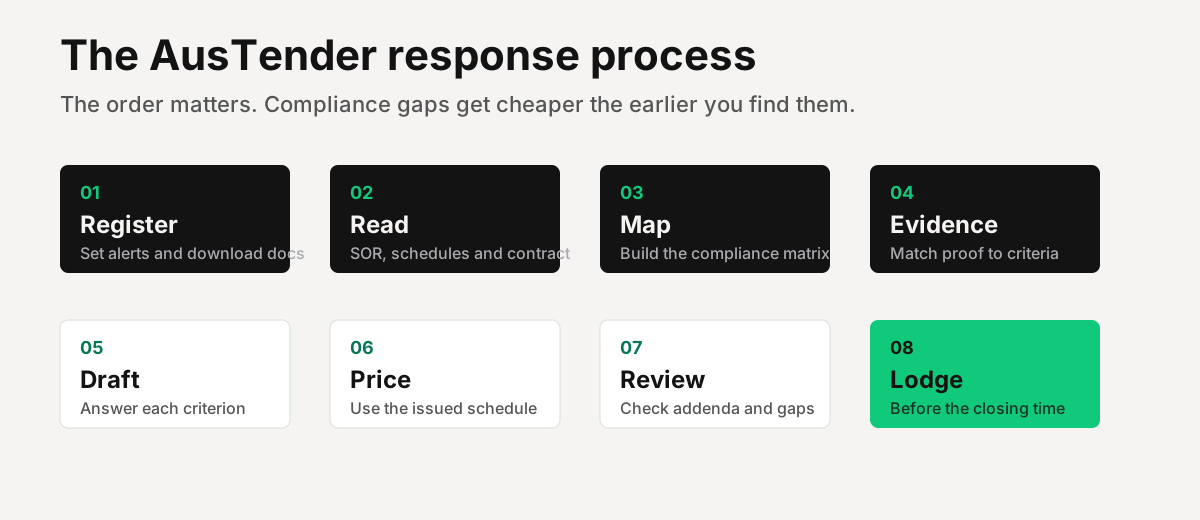
A compliant response is built in order: portal, documents, requirements, evidence, schedules, pricing, review and lodgement.
What is AusTender?
AusTender is the Australian Government's central procurement information system, managed by the Department of Finance at tenders.gov.au. Commonwealth agencies use it to publish open tender opportunities, annual procurement plans, standing offer notices, and the details of contracts they award at or above $10,000. Registration is free and any business can respond to open opportunities.
AusTender covers Commonwealth work only. States, territories and councils run their own portals. If you sell across levels of government you will live in several systems, but AusTender is the largest single source of public opportunities in the country.
It is also the best free research tool in Australian tendering, and most bidders never use it that way. Contract notices show which agencies buy what you sell, what they paid, and who won. Annual procurement plans show what is coming to market this year. The best time to prepare for a tender is before it is published, and AusTender tells you what is coming.
Types of AusTender opportunities (ATM, RFT, RFQ, EOI)
Approach to Market, or ATM, is the umbrella term for any AusTender notice inviting suppliers into a procurement. Underneath it sit four response types that ask for different things. Responding to one as if it were another is a common and avoidable way to lose.
Request for Tender (RFT). A full, binding offer against a detailed Statement of Requirements. Evaluation criteria, returnable schedules, pricing, and usually a draft contract. The most demanding response type, and the one most of this guide is about.
Request for Quote (RFQ). Shorter, usually lower value, often run through an established panel. Price plus a tight capability statement. Precision beats prose here.
Expression of Interest (EOI). A first-stage filter. The agency wants a shortlist before issuing the full RFT. You are not bidding yet. Your job is to prove credible capability and get through the gate, not to write the whole solution early.
Request for Information (RFI). Market research. No contract at the end, but a strong RFI response can shape the eventual requirement and puts your name in front of the agency before the real race starts.
You will also see standing offer notices, which record panel arrangements. A large share of Commonwealth buying, especially in ICT and professional services, runs as RFQs among panel members rather than open tenders. Watching for panel refreshes is a long game worth playing.
How the Commonwealth Procurement Rules affect your response
The Commonwealth Procurement Rules, the CPRs, are the rules agencies must follow when they buy. The current version commenced on 17 November 2025. The core test is value for money. Not the lowest price. The best overall outcome, assessed against published criteria. The full rules are on the Department of Finance site.
Four parts of the CPRs matter directly to your bid team.
The thresholds decide the process you face. At or above $125,000 (GST inclusive) for non-corporate Commonwealth entities, $400,000 for prescribed corporate Commonwealth entities, or $7.5 million for construction services, agencies must generally go to open tender through AusTender. The $125,000 figure is new from 17 November 2025, up from $80,000.
Below the threshold, Australian businesses get priority. For non-construction procurement between $10,000 and $125,000, non-corporate Commonwealth entities must invite only Australian businesses to quote, subject to the Indigenous Procurement Policy. The same applies to construction between $10,000 and $7.5 million. If you are an Australian SME, the rules now lean your way at this end of the market, including some panel approaches that must be restricted to SME members.
Minimum response times protect you. Open tenders covered by the rules must allow at least 25 days from publication of the ATM to lodgement. Shorter periods, down to a floor of 10 days, are only allowed in defined cases such as genuine urgency or commercial off-the-shelf purchases. If a deadline looks brutal, the ATM should tell you why.
Conduct is now scored territory. Under the current CPRs, ethical conduct is expressly part of the value for money assessment. Past performance, honesty of claims, behaviour during the process. All in scope. Never overstate capability in a Commonwealth response. It is not just bad practice. It is now directly relevant to how you are assessed.
One more rule worth knowing. Agencies must report awarded contracts of $10,000 or more on AusTender within 42 days of signing. That is why the contract notice database is such a good research tool.
How to register on AusTender
Registration takes minutes at tenders.gov.au and costs nothing. Create an account, set up notifications for the categories and keywords that match your work, and AusTender emails you when matching opportunities go live. You download documents and lodge responses through the portal.
Two settings deserve more care than they get.
Cast the category net wide. Agencies do not always tag opportunities the way you would expect. Register for every category that plausibly touches your work and layer keyword alerts on top. A missed notification is a tender you never knew existed.
Watch for addenda. Agencies issue addenda that change requirements, answer questions, and move deadlines. Registered users who downloaded the documents get notified, but checking you are working from the latest version before you lodge is your responsibility. Responding to a superseded requirement is a self-inflicted loss.
Reading the Statement of Requirements
The Statement of Requirements defines what the agency actually wants to buy. Read it before anything else. Read it twice. Every hour spent here saves three in the final week.
As you read, sort the package into four piles.
Conditions for participation. Pass or fail gates. Licences, certifications, insurances, financial viability. If you cannot meet one, that is your bid or no-bid decision made early, before the hours are sunk.
Mandatory requirements. Anything labelled must or shall. These are not scored on a scale. Miss one and a compliant evaluation process sets your response aside, no matter how good the rest of it is.
Weighted evaluation criteria. The scored questions. Capability, methodology, personnel, past performance, price. This is where tenders are won and where your writing hours belong.
The draft contract. Commonwealth RFTs almost always include one. Read it before you price. Risk allocation, liability caps and payment terms belong in your pricing decision, not in a panicked review after you have won.
Turn those piles into a requirement-by-requirement list before you write a word. That list becomes your compliance matrix, covered below.
What Commonwealth evaluators score and how
Commonwealth evaluation is structured and documented. A panel works to a pre-approved evaluation plan, scores each response against the published criteria, and recommends the best value for money. Evaluators can only score what is on the page. They cannot give you credit for capability you did not evidence.
It usually runs in two stages. First the compliance check. Lodged on time, mandatory forms complete, conditions for participation met, mandatory requirements addressed. Fail here and scoring never starts. Then the scored evaluation against the weighted criteria.
When the CPRs say value for money, they point evaluators at quality, fitness for purpose, relevant experience and performance history, flexibility, environmental sustainability, whole-of-life costs and, under the current rules, ethical conduct. Price matters. But a cheap response with thin evidence loses to a well-evidenced response at a fair price more often than new bidders expect.
The practical lessons are short. Answer the criterion that was asked, in the language it was asked in. Make every claim specific enough to verify. Put a number, a client or a named project behind each one. Spend your effort by the published weightings, not by which sections are easiest to write.
How to structure an RFT response
The structure is usually decided for you. Most Commonwealth RFTs include returnable schedules or response templates, and you complete them exactly as issued. Do not reorganise them. Do not merge them. Do not substitute your own format. Evaluators score dozens of responses against a fixed plan, and a response that breaks the structure makes their job harder and your score lower.
Inside each schedule, where the content is yours to control, one pattern holds up: direct answer, then method, then evidence. Open with one or two sentences that answer the criterion outright. Follow with how you will deliver. Close with proof. A named project, an outcome, a number. Evaluators skim before they score, and a buried answer reads as no answer.
A full RFT response typically includes a cover letter, completed compliance statements and mandatory forms, a response to each evaluation criterion, key personnel CVs aligned to the roles in the Statement of Requirements, case studies chosen for this buyer and this scope, the pricing schedule in the issued format, and supporting documents such as insurances and policies. Every piece exists because the RFT asked for it. Padding does not score.
How AI Automates Compliance Matrices for AusTender Submissions
AI assists with compliance matrices by reading the full RFT package, extracting requirements into structured rows, linking each row to a response and then flagging gaps. A compliance matrix is a table listing every requirement in the RFT, mapped to the section of your response that addresses it, with a compliance status against each row. Some Commonwealth RFTs require one as a returnable schedule. Even when they do not, building one is one of the most effective disciplines in Commonwealth tendering.
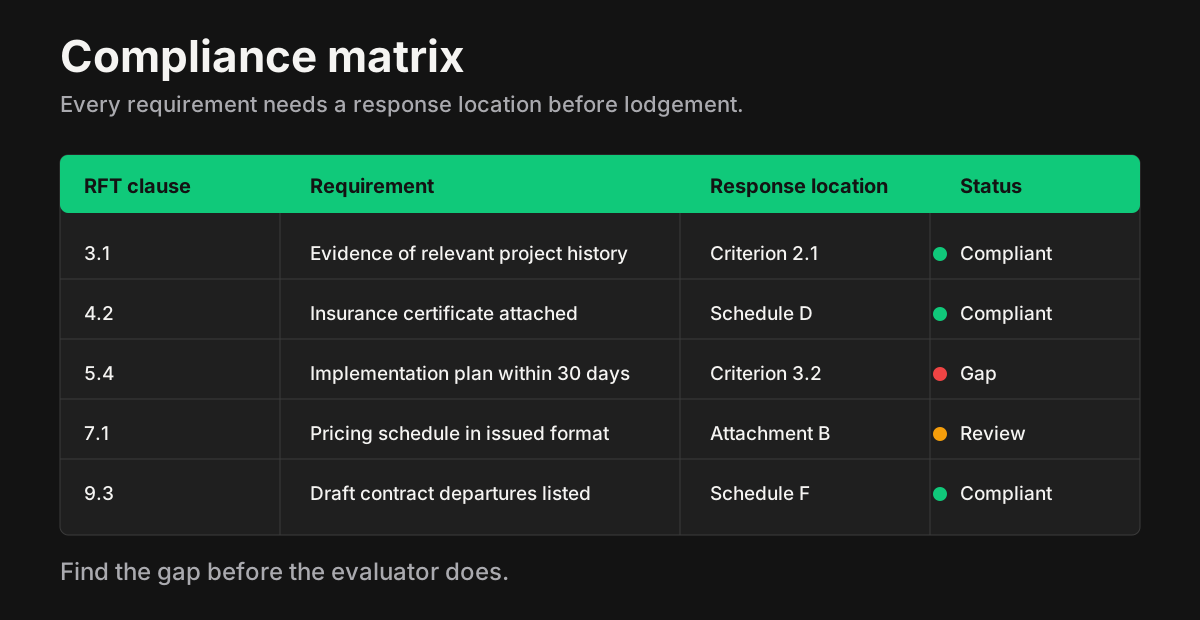
The matrix turns a long RFT into a visible gap list before the evaluator finds the gaps for you.
Here is the AI-assisted process:
- Upload the Request for Tender (RFT). Include the Statement of Requirements, conditions of tender, returnable schedules, draft contract and every addendum so the review covers the complete package.
- AI extracts mandatory criteria and other obligations. It identifies numbered requirements, conditions for participation, every must and shall, evaluation criteria, required forms and submission instructions, while retaining the source clause for verification.
- AI generates the compliance matrix. Each criterion receives a row with its source, requirement type, owner, response location, evidence and status such as not started, in progress, compliant, partially compliant or non-compliant.
- AI flags gaps before submission. Missing answers, unsupported claims, incomplete schedules and rows without a response location become a review list for the bid team.
The matrix should remain a live control document throughout the bid. When an addendum changes a clause or a writer moves an answer, update the relevant row. AI speeds up extraction and checking; it does not replace the bid manager's final review against the original RFT.
| Measure | Manual matrix | AI-assisted matrix |
|---|---|---|
| Time | Requirements are copied and classified one by one; effort grows with document length and addenda. | Produces a first-pass matrix quickly, leaving the team to verify, assign and refine it. |
| Error risk | Manual copying can miss clauses, duplicate rows or lose the source reference. | Applies a consistent extraction pass and highlights uncertain items, subject to human verification. |
| Completeness | Depends on repeated manual cross-checking across every document and schedule. | Checks the uploaded package systematically and flags requirements without a status, response or evidence link. |
| AusTender alignment | The bid team must manually preserve clause numbers, returnable schedules and addendum changes. | Maps rows back to the RFT structure and source clauses, making the final AusTender review easier to audit. |
A compliance matrix also supports evidence-backed tender responses. Once each criterion is structured, AI software can match it to approved case studies, CVs, policies and performance data. The writer can then see which claims have evidence and which still need proof. For a broader workflow, read AI-assisted tender response support for Australian SMEs, or use the tender response ROI calculator to estimate the cost of your current bid process.
Common AusTender submission mistakes
The same mistakes sink Commonwealth responses year after year. None of them are about writing quality.
Lodging late. AusTender deadlines are absolute. An agency cannot accept a late response unless the delay was caused solely by mishandling on its own side. Minutes count. Plan to lodge the day before close, not the hour before.
Leaving upload to the last hour. Big files, slow connections, portal traffic at deadline. All predictable. Only a crisis if you made them one.
Missing an addendum. Requirements move mid-process. Answering the original documents after an addendum has shifted the goalposts is a compliance failure you will not see coming.
Failing a mandatory requirement. An unsigned declaration, a missed form, an insurance certificate below the required cover. The gateway check does not award partial credit.
Describing yourself instead of answering the question. A capability statement pasted in as a criterion response scores poorly every time. Answer the specific question, in the buyer's language, with evidence.
Ignoring the draft contract until after award. Careless qualifications can make a response non-conforming, and terms nobody read can make a won contract unprofitable.
Bidding on everything. A weak response costs nearly as much to produce as a strong one. An early, honest bid or no-bid call against the conditions for participation is worth more than any writing technique.
Frequently Asked Questions About AusTender Compliance Matrices
What is a compliance matrix in a government tender?
A compliance matrix is a requirement-by-requirement control table. It records the source clause, what the buyer requires, whether the requirement is mandatory or scored, who owns the response, its status, where the answer appears and what evidence supports it.
Does AusTender require a compliance matrix?
Not for every opportunity. AusTender is the publication and lodgement system; the specific RFT sets the response requirements. If the tender includes a compliance matrix as a returnable schedule, complete and submit it in the required format. If it does not, an internal matrix is still valuable for controlling completeness.
Can AI tools auto-populate compliance matrices from RFT documents?
Yes. AI tools can extract clauses, classify mandatory and scored requirements, retain source references and create a first-pass matrix. The bid team should verify the output against every RFT document and addendum because document formatting, tables and cross-references can cause extraction errors.
How does AI assist with compliance matrices for AusTender submissions?
AI reviews the uploaded tender package, turns requirements into structured rows, maps them to draft responses and evidence, and flags missing or partial items before lodgement. This reduces manual administration and gives the bid manager a traceable review list; final compliance decisions remain with the human team.
How Doreva helps with AusTender responses
Doreva is AI tender writing software built for Australian Government procurement. It is built around the exact work this guide describes.
You load the material your team already trusts. Case studies, CVs, certifications, policies, past tender responses, pricing inputs. When an AusTender opportunity lands, Doreva reads the tender documents, builds the compliance matrix, and matches your evidence to the published evaluation criteria. Then it drafts each section against the criterion that was asked, drawing on your evidence.
No invented project names. No made-up dollar values. No unsupported claims sliding quietly into the submission.
Before you lodge, Doreva scores the draft against the criteria, so the thin sections show up while there is still time to fix them. Every section needs human review before export. The export is a government-formatted DOCX with an AI Use Statement included, so the buyer knows how AI was used. Imported tenders are confidential by default and your data is hosted in Australia.
The bid writer still makes the calls. Which case study fits this agency. Which claim the evidence can honestly carry. Which pricing story survives a clarification meeting.
Doreva carries the slow work. The bid team carries the judgement.
Your next AusTender response, drafted from your own evidence.
Start the free pilot with a live opportunity. Doreva reads the pack and shows the deadlines, requirements and evaluation criteria. Upgrade when you are ready for the compliance matrix, the evidence matching, and a first draft your bid team can review and own.
Start Free PilotBuilt and hosted in Australia. Your tender data stays here.
Sources: AusTender, Commonwealth Procurement Rules, Department of Finance, Selling to Government, Department of Finance. Thresholds and timeframes current as at June 2026 under the Commonwealth Procurement Rules commencing 17 November 2025. Verify current requirements against the official documents for any live procurement.